Assessment in the Honors College
The Honors College assesses two categories of student learning: BA curriculum and core curriculum. The Assessment Director works closely with the University’s Office of Assessment and works to follow best practices in all areas, including design of assessment tools; collection of data; and analysis of data for adjusting and improving teaching.
BA Curriculum
Student Learning Outcomes for the BA:
CCurrently, college-level assessment in the Honors College occurs in all 1000- and 400-level courses. Honors faculty have developed six Student Learning Outcomes to measure student learning. Those outcomes will be assessed on a three-year schedule:
- Academic Year 2026-2027: No college-level assessment will be done at UNM
- Academic Year 2027-2028: Interdisciplinarity; Creative Thinking
- Academic Year 2028-2029: Communication; Community-Engaged Learning
- Academic Year 2029-2030: Research; Critical Thinking
Interdisciplinarity:
At the end of their careers in Honors, students will be able to:
- Connect two or more approaches to a single problem or project.
- Integrate diverse knowledge, perspectives, or skills into a unified argument or strategy.
Critical Thinking:
At the end of their careers in Honors, students will be able to:
- Evaluate perspectives from multiple sides of a topic or argument.
- Identify implications and consequences of arguments and conclusions.
Communication:
At the end of their careers in Honors, students will be able to:
- Employ appropriate strategies to address rhetorical situations (audience, purpose, stance, genre, media/design).
- Present clearly organized, precise, and persuasive arguments or documents in multiple formats.
Research:
At the end of their careers in Honors, students will be able to:
- Identify a substantive research question or problem.
- Develop original knowledge or meaning through the systematic study of a problem, topic, or prompt.
Creative Thinking
At the end of their careers in Honors, students will be able to:
- Craft a material, process, or text through deliberate manipulation of tools and methods.
- Take risks and solve problems through iteration, revision, exploration, and critique.
- Articulate the formal and conceptual motivations of their work.
Community Engaged Learning:
At the end of their careers in Honors, students will be able to do at least one of the following:
- Collaborate with community partners to contribute to the public good.
- Apply skills across or within communities through mutually beneficial exchanges of knowledge.
- Demonstrate cross-cultural understanding by interacting with local, regional, national, or global communities.
The deadlines for submitting college-level assessment materials to the Honors Assessment Coordinator are as follows:
- Materials from the fall semester: February 1
- Materials from the spring semester: June 1
Further details, including the relevant rubrics and the process for completing and submitting materials, will be provided to faculty by Honors Assessment Coordinator, Dr. Renée Faubion (sanren@unm.edu).
Gen Ed Curriculum
Student Learning Outcomes for Gen Ed Curriculum:
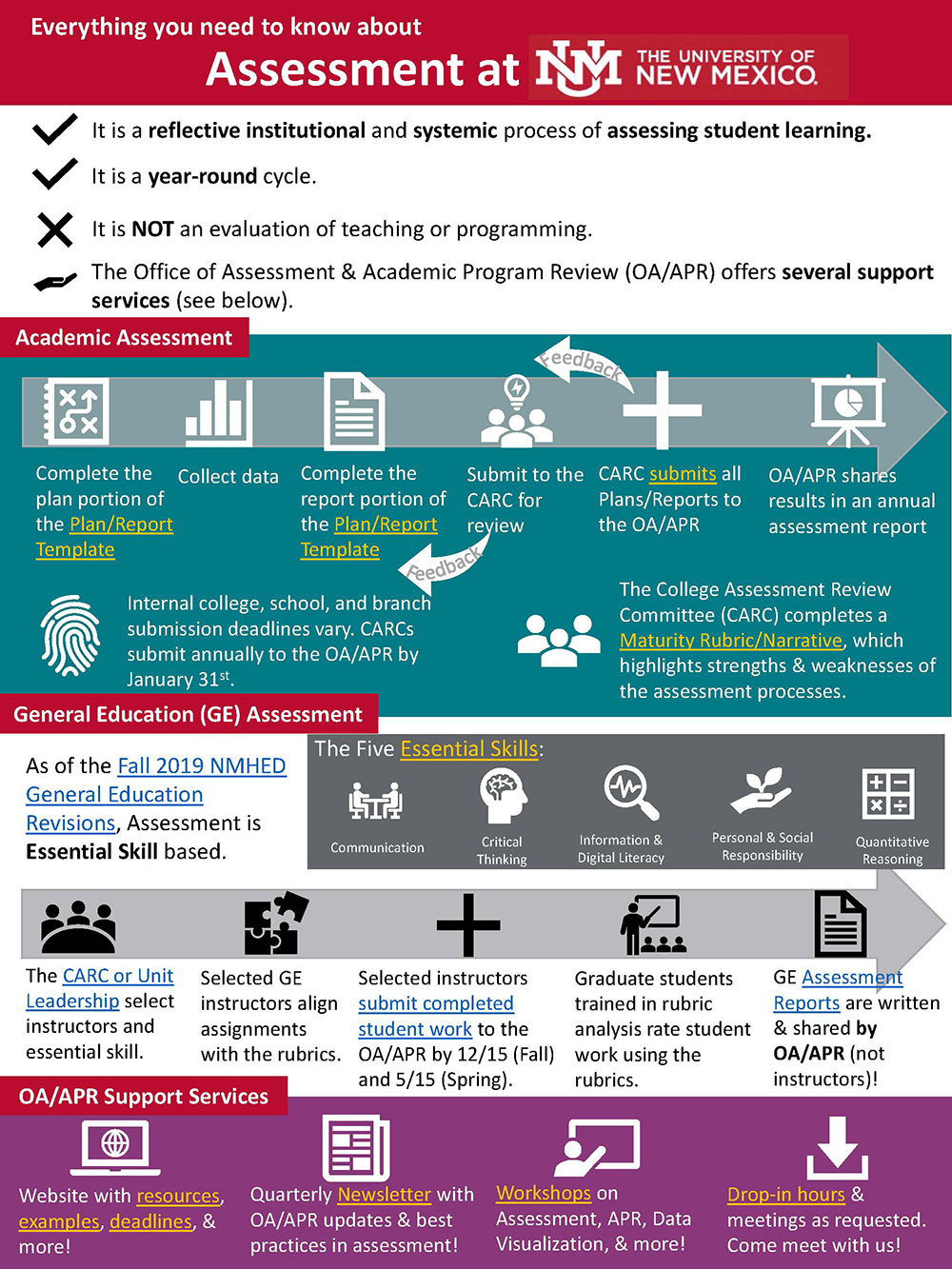
Gen Ed assessment occurs in all 1000- and 2000-level Honors courses. In Gen Ed Assessment, faculty are required by the state to evaluate Essential Skills against mandated rubrics on a particular schedule. The Essential Skills for each area and their rubrics are available at this website:
Essential Skills for each area will be assessed on a three-year schedule:
- Academic Year 2026-2027
- All Gen Ed courses will assess Critical Thinking
- Academic Year 2027-2028
- (HNRS 2112) Writing and Speaking: Information and Digital Literacy
- (HNRS 2113) Fine Arts: Communication
- (HNRS 2221) Mathematics and Statistics: Communication
- (HNRS 2331) Physical and Natural Sciences: Personal and Social Responsibility
- (HNRS 2364) Social and Behavioral Sciences: Personal and Social Responsibility
- (HNRS 1120 and 2167) Humanities: Personal and Social Responsibility
- Academic year 2028-2029
- (HNRS 2112) Writing and Speaking: Communication
- (HNRS 2113) Fine Arts: Personal and Social Responsibility
- (HNRS 2221) Mathematics and Statistics: Quantitative Reasoning
- (HNRS 2331) Physical and Natural Sciences: Quantitative Reasoning
- (HNRS 2364) Social and Behavioral Sciences: Communication
- (HNRS 1120 and 2167) Humanities: Information and Digital Literacy
The deadline for submitting materials to the Office of Assessment is Dec. 15 for the fall semester and May 15 for the spring semester. Further details, including the relevant rubrics and the process for completing and submitting materials, will be provided to faculty by Honors Assessment Coordinator, Dr. Renée Faubion ( sanren@unm.edu).
Writing SLOs FAQ
Writing student-learning outcomes (SLOs) for Honors courses:
Every syllabus must include student learning outcomes. The Honors College faculty have already written PSLOs for the college; these materials are located in the BA Curriculum tab, and they are broken down into course-level SLOs. Please represent at least one or two of these PSLOs in your course syllabus and adapt them to the particular topic of the course. You might do this by inserting a phrase in the SLO. For example, if the SLO you want to use under Critical Thinking indicates that students will define common biases and heuristics that prevent critical thinking, you might add “to controversies in human rights” if that later element reflects the focus of the course. You may also want to add additional SLOs of your own design as appropriate to your course.
Please also remember that the state has mandated Essential Skills for 100- and 200-level courses across the university. That information can be found in the Gen Ed Curriculum tab and should be considered in designing courses and syllabi.
Tips for writing new SLOs:
- Student learning outcomes need not summarize everything you want to accomplish in the course. They are meant to provide some measurable guidelines for your students.
- Since they need to be measured/assessed you do not want to have too many. Four to six is usually an adequate number of SLOs.
- Also since they need to be measured they should have an active verb in the sentence. For example, “Upon completion of this course students will be able to define important concepts in archaeology.” Define is measurable. Avoid verbs such as appreciate since that is deemed unmeasurable in the context of assessment.
- It is expected that a range of skills will be represented in a set of SLOs. Refer to Bloom’s taxonomy for a scale and a list of accompanying verbs. That is, in addition to requiring students to memorize something, faculty might also require the higher order skill of analyzing something.
Good SLOs facilitate clarity in course goals, content, and evaluation. They help students understand what is expected of them. They also facilitate fairness in grading, and allow the faculty to determine which activities and materials are effective or not. (adapted from Designing and Assessing Courses and Curricula: A Practical Guide, R. Diamond)
Assessment at UNM
Required addition by Office of Assessment

Social Media
For news, information, prizes and more fun stuff follow us on our social media!
Honors College Resources