Declaring Independence
 Presented at the Zimmerman Library, June 26th – August 3rd, 2026,
in commemoration of the 250th anniversary of the
Declaration of Independence and the birth of the United States of America.
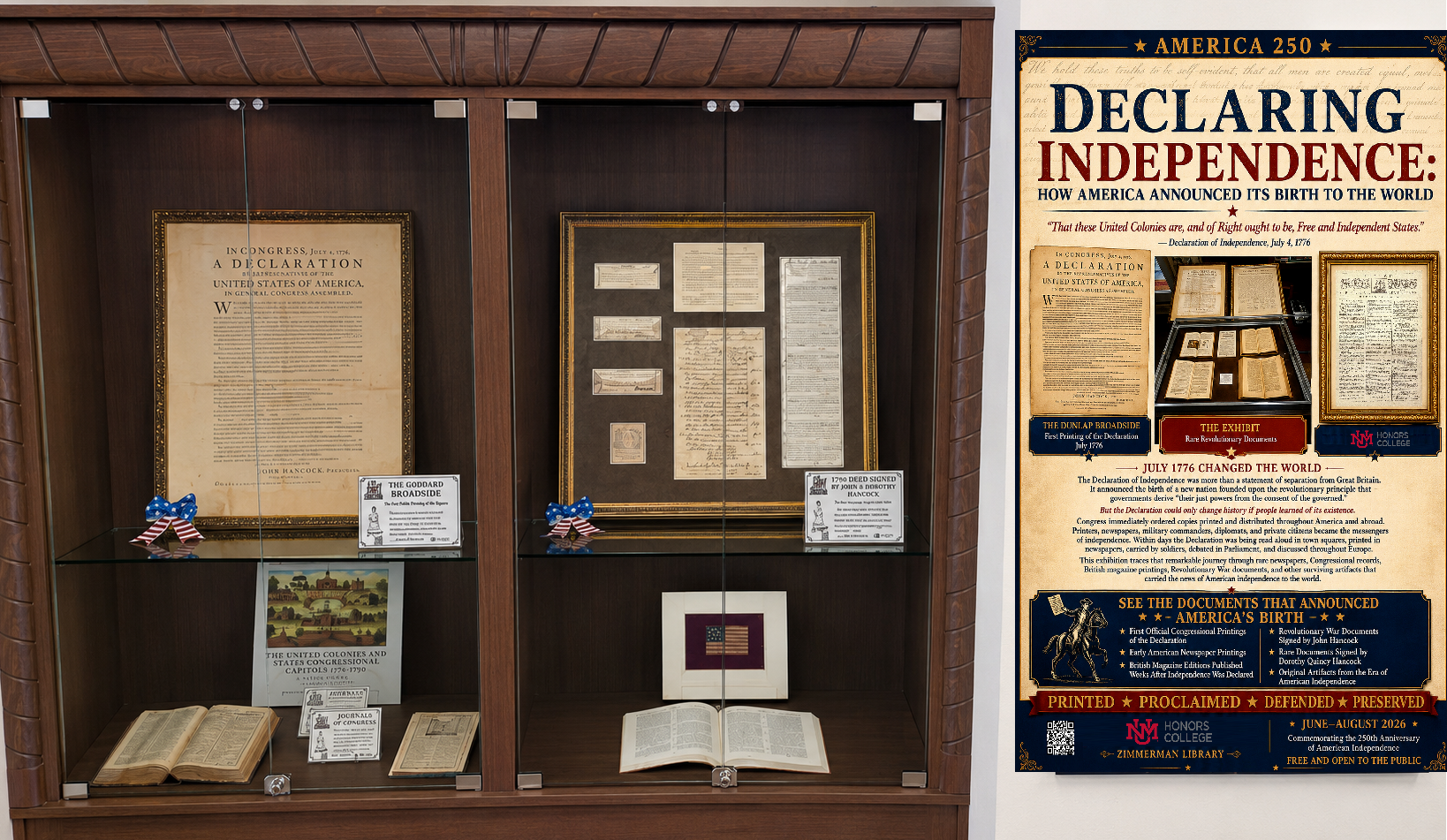
DECLARING INDEPENDENCE: HOW AMERICA ANNOUNCED ITS BIRTH TO THE WORLD
July 1776 marked one of the most consequential moments in human history. Meeting in Philadelphia, the Continental Congress voted to sever political ties with Great Britain and proclaim the thirteen colonies to be “Free and Independent States.” The Declaration of Independence was more than a statement of separation; it was a revolutionary assertion that governments derive “their just powers from the consent of the governed” and that the people possess the right to alter or abolish governments that violate their liberties.
Yet the Declaration could only change history if people learned of its existence. Immediately after its adoption, Congress ordered copies printed and distributed throughout America and abroad. Printers, newspapers, military commanders, diplomats, and private citizens became the messengers of independence. Within days, the Declaration was being read aloud in town squares, printed in newspapers, carried by soldiers, debated in Parliament, and discussed throughout Europe. The documents displayed in this exhibit trace that remarkable journey, from the first printed announcements of independence in July 1776 to official congressional records, British magazine printings, Revolutionary War commissions signed by John Hancock, and later efforts to preserve the fading text for future generations.
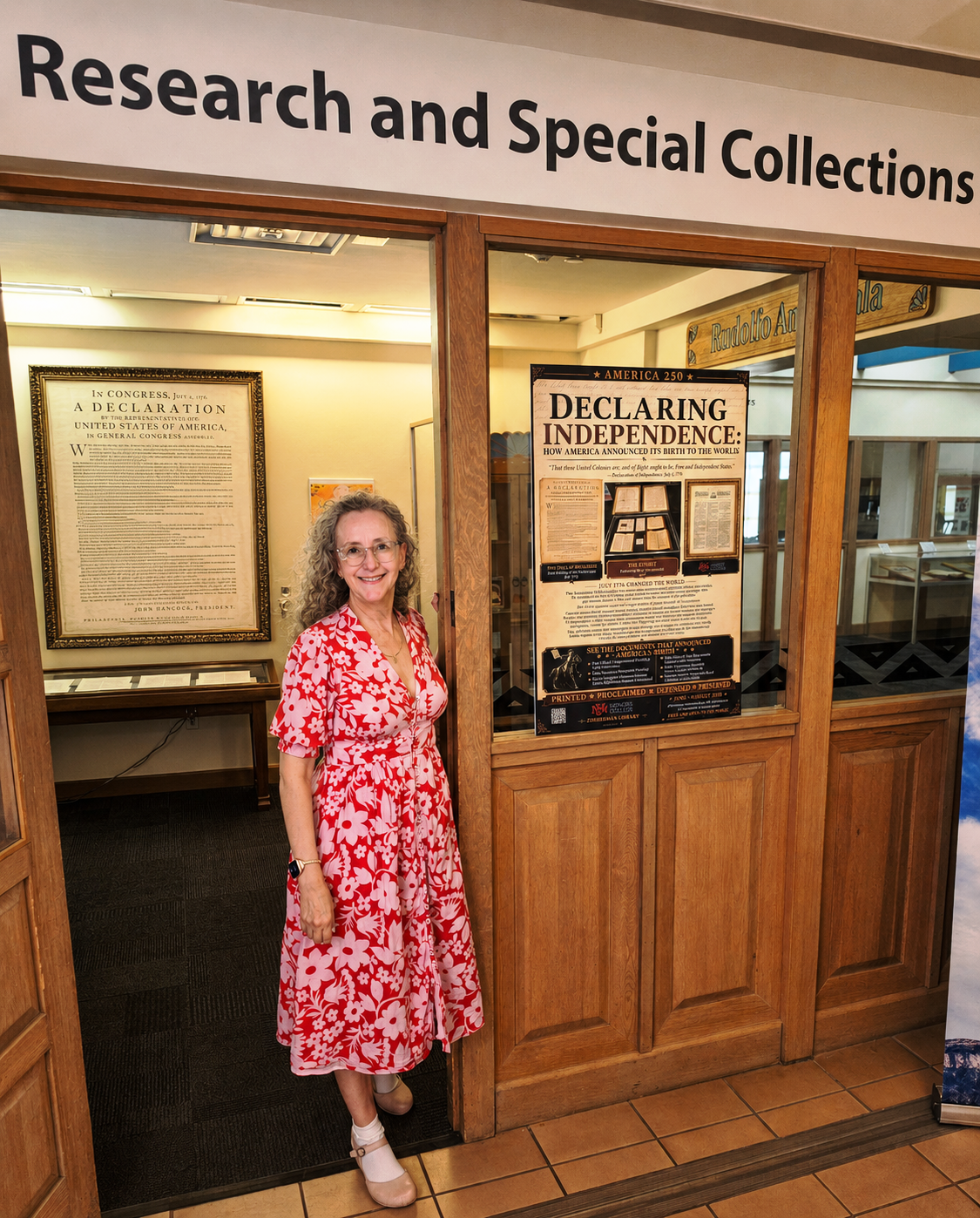
Dr. Naomi Yavneh Klos, Dean of the University of New Mexico Honors College, welcomes visitors to Declaring Independence: How America Announced Its Birth to the World, an exhibition featuring rare original artifacts that trace the Declaration of Independence from its adoption in Philadelphia to its publication throughout America and abroad.
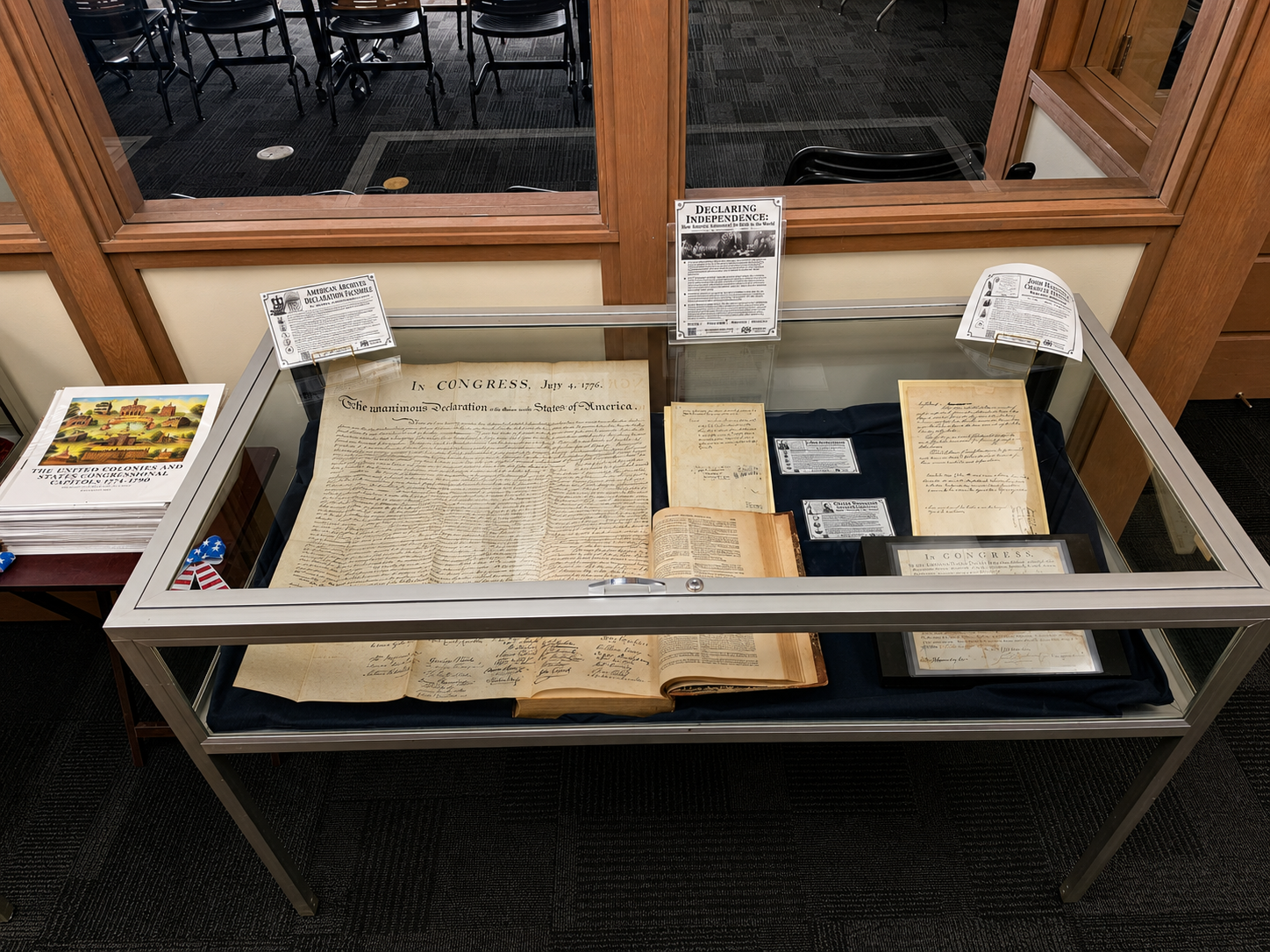
Together, these artifacts tell the story of how a declaration drafted in Philadelphia became a global event. They reveal not only the creation of the United States, but also the means by which revolutionary ideas were communicated, preserved, and remembered. As we commemorate the 250th anniversary of American Independence, these original documents remind us that the Declaration was not merely written—it was printed, distributed, debated, defended, and ultimately enshrined as one of the most influential statements of liberty in world history.


Journals of Congress, 1776: First Congressional Printing of the Declaration of Independence
This rare 1776 edition of the Journals of Congress contains the first official Congressional printing of the Declaration of Independence, appearing on pages 241–246. Printed by Robert Aitken in Philadelphia under the authority of Congress in 1777, it preserves the proceedings of the Second Continental Congress during the pivotal year in which the American colonies formally declared themselves free and independent states.
Unlike broadside and newspaper printings intended for public dissemination, the Journals served as the official record of Congressional actions and debates, produced primarily for delegates, government officials, and foreign representatives. As such, this volume occupies a unique place in American history: it is the earliest authorized book-form appearance of the Declaration issued directly under congressional supervision. The text records not only the Declaration itself but also the legislative actions that transformed a colonial rebellion into the birth of a new nation.
Robert Aitken, Congress’s official printer, undertook publication under difficult wartime conditions. The volume was printed while the Revolutionary War was still being fought and at a time when the survival of the American cause remained uncertain. Shortly after its publication, British forces occupied Philadelphia, disrupting governmental operations and placing many official records at risk. Consequently, relatively few copies of this first edition survived, and those that did often suffered heavy use by officials and institutions.
Today, the 1776 Journals of Congress stand among the most important and sought-after printed records of the American Revolution. It preserves the first official Congressional printing of the nation’s founding document within the broader context of the legislative proceedings that gave birth to the United States. As both a historical artifact and a witness to the creation of American independence, it offers a direct connection to the men, events, and decisions that shaped the founding of the Republic.
The Lee Resolution for Independence: America’s True Vote for Freedom
Exhibited here are two important nineteenth-century printings preserving the historic Resolution for Independence adopted by the Continental Congress on July 2, 1776. Together, these documents commemorate the decisive congressional action that transformed thirteen British colonies into free and independent states.
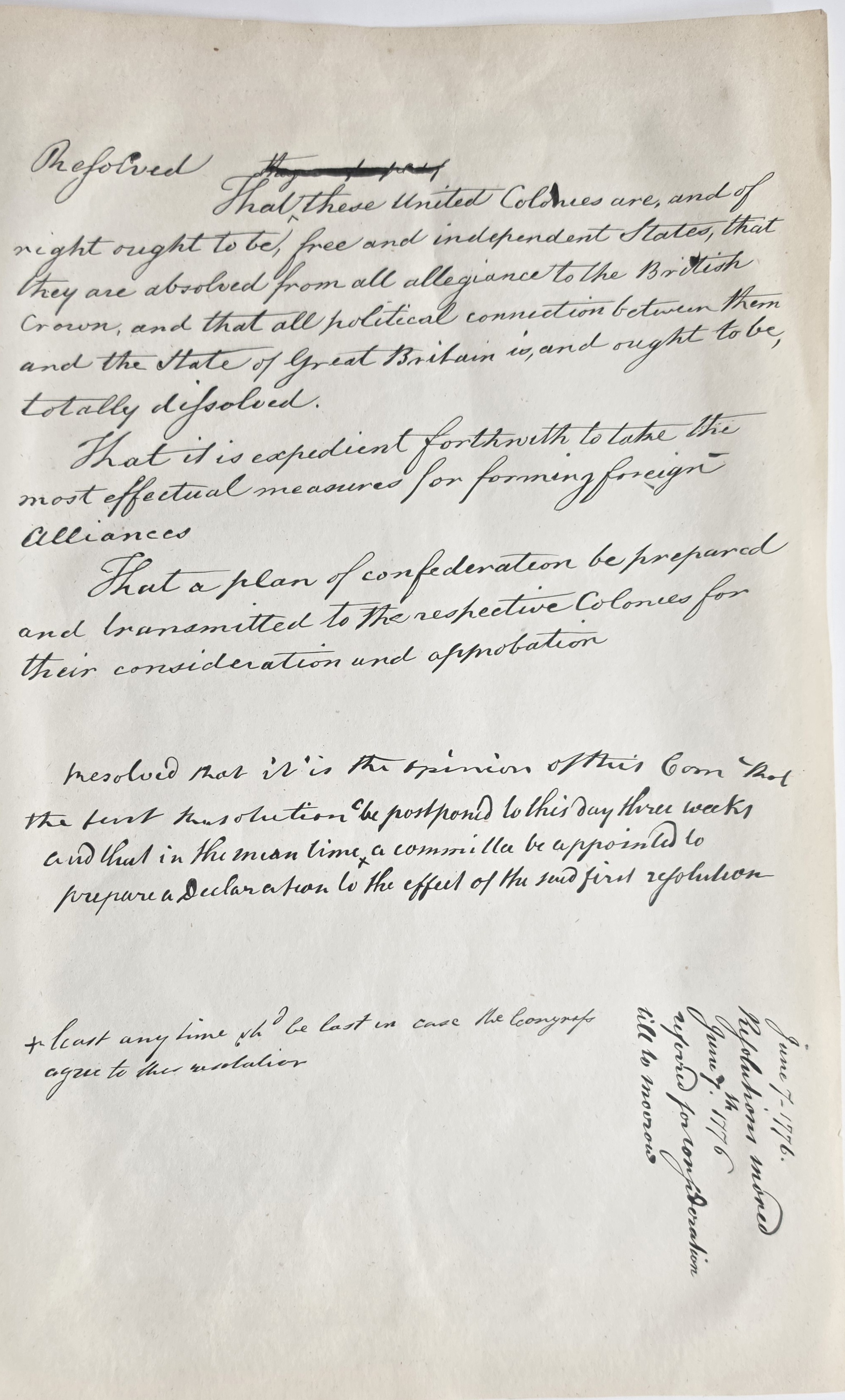
The first item is the 1833 American Archives printing of Richard Henry Lee’s original resolution as introduced before Congress on June 7, 1776. Acting under instructions from the Virginia Convention, Lee proposed “that these United Colonies are, and of right ought to be, free and independent States.” His resolution also called for the establishment of foreign alliances and the preparation of a plan of confederation. These three measures became the legislative blueprint for the creation of a new nation.
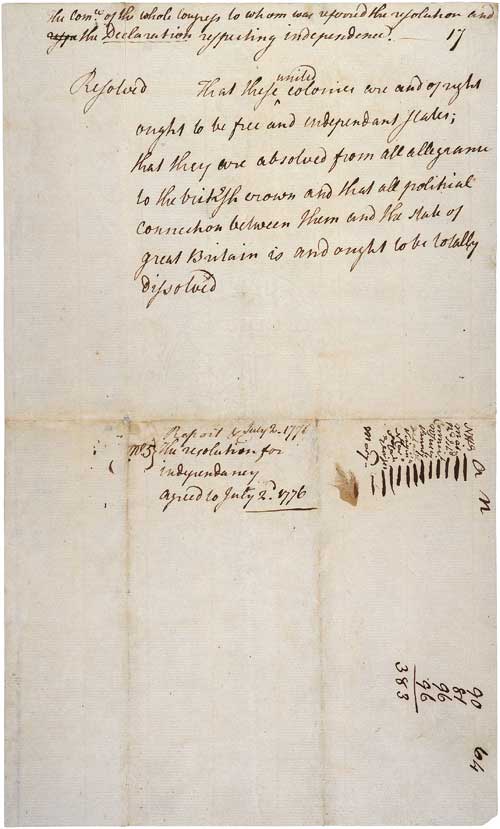
Also exhibited is a nineteenth-century copy of the historic Resolution for Independence adopted by the Continental Congress on July 2, 1776. The text is reproduced in the distinctive handwriting of Charles Thomson, the long-serving Secretary of the Continental Congress, whose careful recordkeeping preserved the official proceedings of the American Revolution.
Introduced by Virginia delegate Richard Henry Lee on June 7, 1776, the resolution declared “that these United Colonies are, and of right ought to be, free and independent States.” After weeks of debate, Congress approved the measure on July 2, severing all political allegiance to Great Britain. Two days later, Congress adopted Thomas Jefferson’s Declaration of Independence to explain and justify that momentous decision to the world, naming the new republic the United States of America.
This resolution, not the Declaration itself, was the actual act of independence. John Adams later wrote that July 2 would be remembered by future generations as the nation’s true birthday because it was the day Congress voted to dissolve its connection with the British Crown.
Particularly noteworthy are Thomson’s tally marks at the lower right, recording the votes of the colonies. Twelve colonies voted in favor of independence, while the Province of New York abstained pending further instructions from its provincial convention. New York would subsequently endorse independence on July 9, allowing Congress to describe its action as the “unanimous Declaration of the thirteen United States of America.”
As the principal administrative officer of Congress from 1774 to 1789, Charles Thomson witnessed and recorded every major step in the founding of the nation. This manuscript preserves the precise words that transformed thirteen British colonies into free and independent states and stands as one of the most significant resolutions in American history.
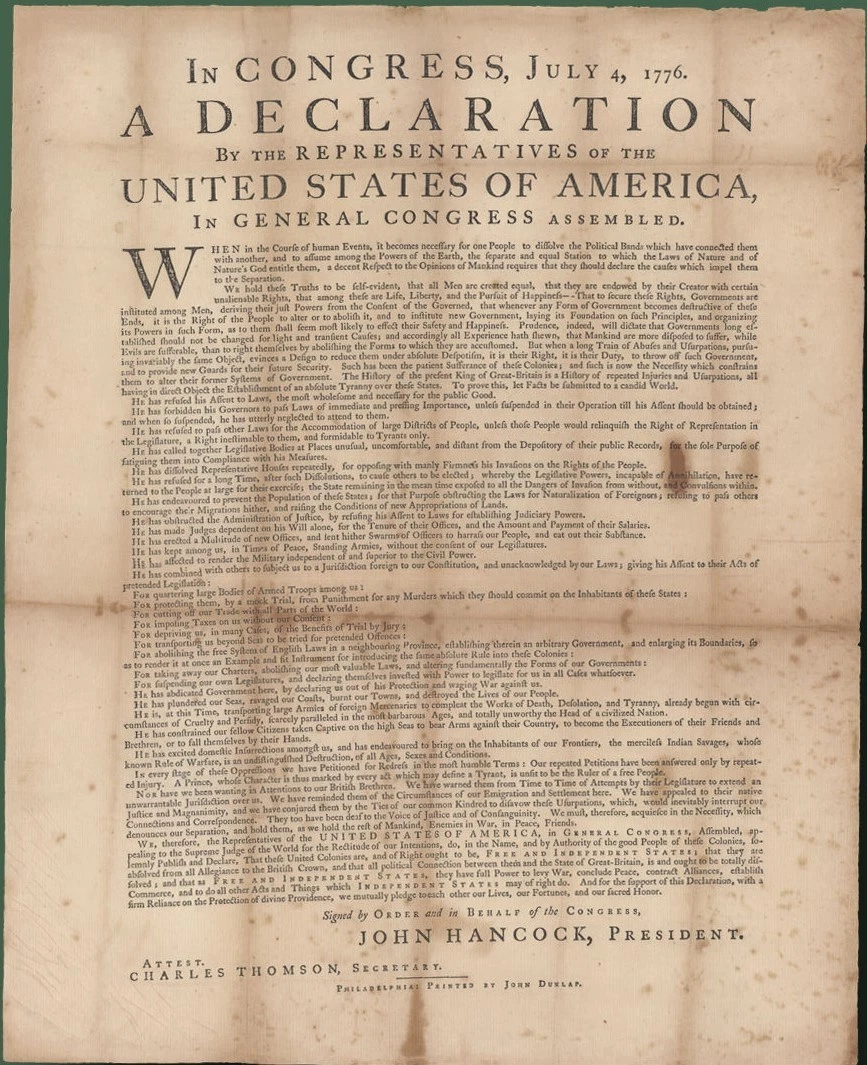
Declaration of Independence Broadside: John Dunlap Facsimile of the Declaration of Independence
This exhibit features a rare facsimile of John Dunlap’s historic July 1776 broadside of the Declaration of Independence, produced from an original example rediscovered in Philadelphia in 1968. The broadside reproduces the form in which Americans first encountered the Declaration and in which King George III received notice of the colonies’ decision to dissolve their political ties with Great Britain. Notably, the title does not yet include the word "unanimous," as New York had abstained from voting for independence on July 2 and July 4 while awaiting instructions from its provincial convention.
On the night of July 4, 1776, Congress ordered Philadelphia printer John Dunlap to produce copies of the newly adopted Declaration. Working through the night, Dunlap printed an estimated 200 broadsides, which were dispatched on July 5 to colonial assemblies, committees of safety, military commanders, and other officials throughout North America. These sheets carried the revolutionary message across the continent and provided the first public announcement of American independence.
Few original examples survive today, making this facsimile an important representation of one of the most influential documents in world history and the moment the United States formally announced its entrance onto the world stage.

Journals of Congress, York-Town Edition: John Dunlap Printing, 1778
When the British Army occupied Philadelphia in September 1777, the Continental Congress was forced to flee the revolutionary capital, carrying with it only a portion of its records and papers. Many official documents were left behind, dispersed, damaged, or lost amid the turmoil of war. Reestablishing itself in York, Pennsylvania, Congress faced the urgent task of preserving the legislative record of the American Revolution while continuing to govern a nation fighting for its survival.
To accomplish this mission, Congress appointed John Dunlap, the printer who had produced the first broadside edition of the Declaration of Independence in July 1776, as its official printer. Working under difficult wartime conditions, Dunlap undertook the publication of the Journals of Congress, creating an enduring record of Congressional proceedings and providing delegates with authoritative reference copies of the actions that shaped the emerging United States.
This rare York-Town edition contains the proceedings of Congress for the critical year of 1776, including an early and highly significant printing of the Declaration of Independence. More than a simple record book, it preserves the official actions by which the thirteen colonies transformed themselves into sovereign states and laid the foundations of American self-government.
The volume also represents a remarkable collaboration between two of Revolutionary America’s most important printers. Robert Aitken, Congress’s Philadelphia printer, issued the first volume before the British occupation disrupted operations in the city. John Dunlap continued the work after Congress relocated to York, ensuring the preservation of the nation’s legislative history during one of its most perilous moments. Together, their efforts created one of the earliest and most authoritative printed records of American independence.
Today, the York-Town Journals of Congress stand as both a rare survivor of the Revolutionary era and a powerful witness to the resilience of the Continental Congress. Printed while the outcome of the war remained uncertain, it preserves the words, decisions, and principles that guided the birth of the United States and remains among the most important documentary artifacts of the American founding.
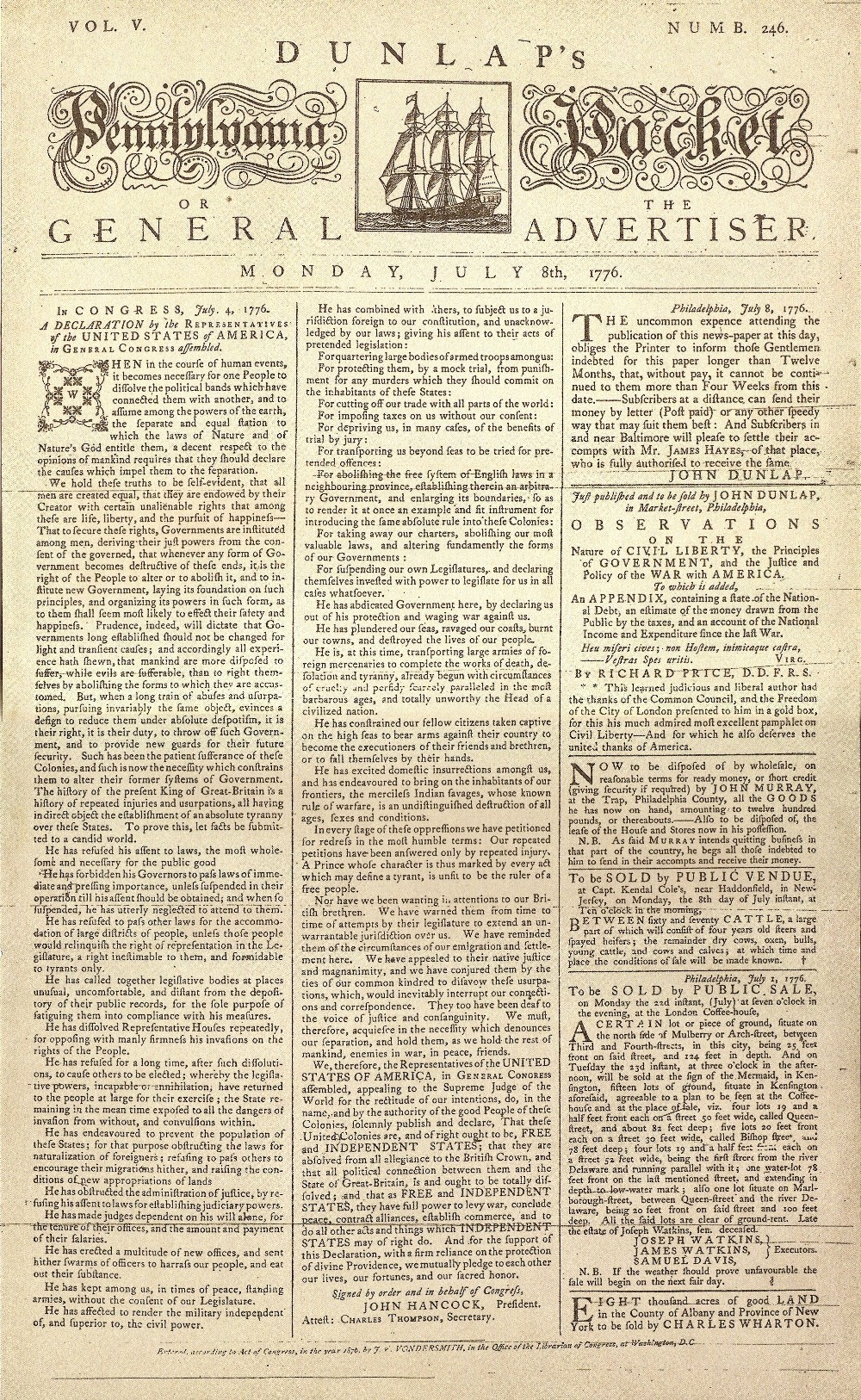
Pennsylvania Packet: July 8, 1776 Newspaper Printing of the Declaration
This Centennial issue of the Pennsylvania Packet contains one of the earliest newspaper printings of the Declaration of Independence. Printed by John Dunlap only days after Congress approved the Declaration, it helped spread news of independence to readers throughout the colonies.
While Dunlap’s broadsides were intended for official distribution, newspapers brought the Declaration directly to the public. Through issues such as this, Americans first read the words that announced the creation of a new nation.
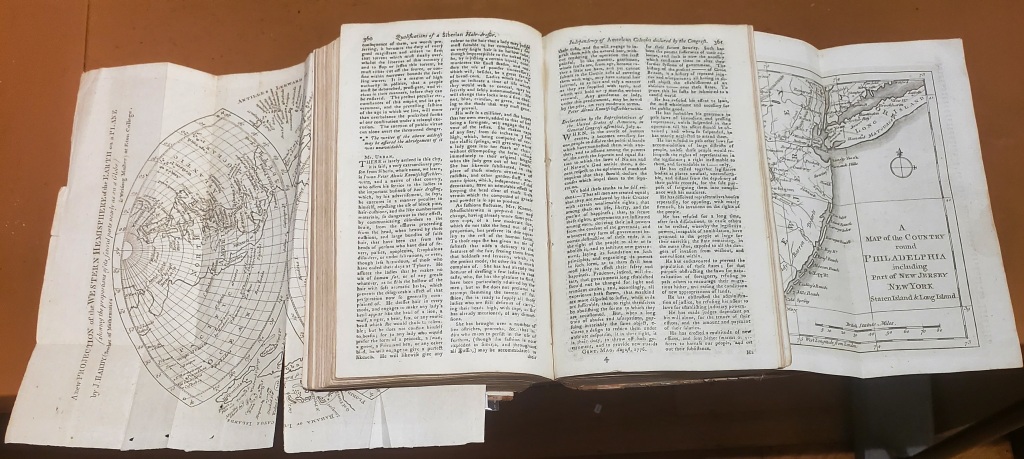
Gentleman’s Magazine: First English Magazine Printing of the Declaration of Independence, August 1776
This August 1776 issue of The Gentleman’s Magazine contains the first appearance of the Declaration of Independence in a British periodical and represents one of the earliest opportunities for the people of Great Britain to read the American colonies’ formal justification for separation from the Crown. Published only weeks after Congress adopted the Declaration in Philadelphia on July 4, 1776, the magazine carried the revolutionary document across the Atlantic and into the homes, coffeehouses, libraries, and political circles of Britain.
Founded in 1731, The Gentleman’s Magazine was among the most influential and widely read publications in the English-speaking world. For decades, it served as a principal source of political news, parliamentary reports, literary commentary, and international affairs. The publication of the Declaration ensured that Americans’ arguments for independence reached a broad British audience at a time when the outcome of the conflict remained uncertain.
The appearance of the Declaration in this issue transformed what had been viewed by many Britons as a colonial rebellion into a direct challenge to the authority of Parliament and King George III. Readers encountered not merely news of resistance but also a carefully reasoned statement asserting the natural rights of mankind, the sovereignty of the people, and the right of a nation to dissolve political bonds with a government deemed destructive of liberty. The document's famous indictment of the King and its assertion that the colonies were “Free and Independent States” ignited debate throughout Britain and Europe.
This issue stands as a remarkable witness to the international impact of the American Revolution. It captures the moment when the Declaration crossed the Atlantic and entered the broader arena of public opinion, diplomacy, and political discourse. As one of the earliest European printings of America’s founding document, it preserves the first encounter many British readers had with the words that announced the birth of the United States and forever altered the course of world history.
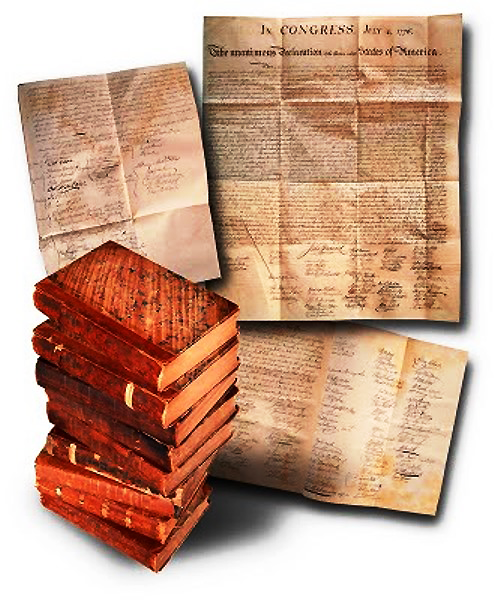
American Archives Declaration Facsimile, William J. Stone Engraving, c. 1833
By the early nineteenth century, the original engrossed Declaration of Independence had begun to fade from handling and display. Secretary of State John Quincy Adams commissioned engraver William J. Stone, in 1820, to engrave an exact facsimile to preserve the document for future generations. Stone completed engraving the copperplate in June 1823 and sold it to the State Department, which had 200 copies printed on parchment. A congressional resolution of May 26, 1824, passed after the prints had been completed, specified the distribution of the 200 engravings to official repositories, significant officeholders, and the surviving signers of the Declaration, including Thomas Jefferson and John Adams.
Many have questioned how Stone made an engraving that captured such an exact image of the parchment original of the Declaration. A Washington newspaper report from 1823 noted that Stone labored for three years to complete the engraving but gave no description of his method. With no contemporaneous account, there is no way to know for sure. Possible methods included tracing by hand or with a tracing device or press copying.
A press copy was made by moistening an ink original and pressing the original against paper to transfer an ink offset, a technique then used to create file copies of letters. In 1881, a National Academy of Sciences committee asserted that the poor condition of the Declaration was the result of a wet copy technique.
With its printing release on parchment in 1823, Stone’s engraving became the definitive image of the Declaration and remains the closest representation of how the signed manuscript appeared in 1776. After the 1823 printing, the imprint line was burnished off the top of the copperplate, and a new imprint was added at the bottom left, below the first column of signatures: "W.J. STONE SC. WASHN." These printings from the Stone copperplate are the same large size but printed on paper rather than parchment. They were issued for Peter Force’s monumental documentary history of the American Revolution, American Archives, authorized by Congress in 1833.
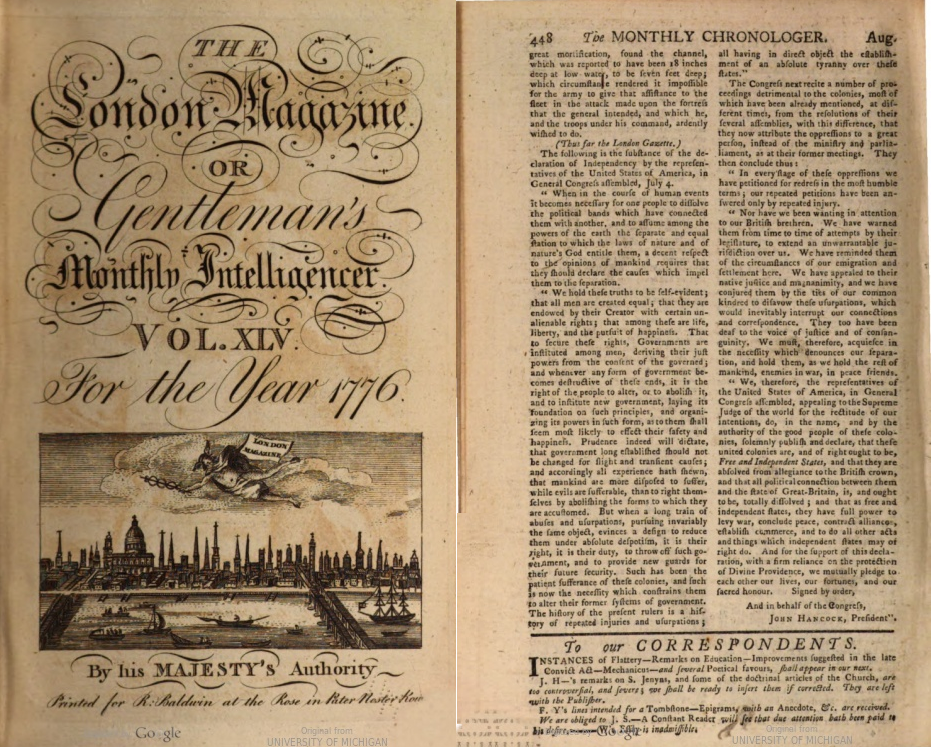
London Magazine: Early British Printing of the Declaration of Independence, 1776
This August 1776 issue of The London Magazine contains one of the earliest British printings of the Declaration of Independence, published only weeks after Congress adopted the document in Philadelphia. Appearing alongside military dispatches, parliamentary news, and political commentary, it provided readers in Great Britain with a firsthand opportunity to examine the American colonies’ justification for separation from the British Empire.
Founded in 1732, The London Magazine was among Britain's leading monthly publications, widely read by merchants, professionals, government officials, and the politically engaged public. Its inclusion of the Declaration reflects the extraordinary interest generated by events in North America as the imperial crisis evolved from armed rebellion into a struggle for national independence. For many British readers, this issue offered their first opportunity to read the complete text of the document that formally dissolved the colonies' allegiance to King George III.
The Declaration appeared in a context shaped by uncertainty and war. British military commanders were reporting on campaigns in America, politicians were debating imperial policy, and newspapers throughout the kingdom were struggling to interpret the rapidly changing situation overseas. Readers encountered not only news of conflict but also the Americans' own explanation of their actions, including their assertion of natural rights, representative government, and the principle that political authority derives from the consent of the governed.
This volume illustrates how closely developments in America were followed in Britain and demonstrates the speed with which revolutionary ideas crossed the Atlantic. It preserves a contemporary record of the moment when the American cause became an international issue, debated not only in colonial assemblies and Continental Congress but also in British drawing rooms, coffeehouses, and Parliament itself.
Today, this rare issue stands as an important artifact of the transatlantic dialogue sparked by the American Revolution. It captures the Declaration of Independence not as a revered founding document viewed through the lens of history, but as breaking news, an audacious announcement that challenged the political order of the eighteenth-century world and commanded the attention of readers throughout the British Empire.

John Hancock & Charles Thomson Military Commission: Signed Revolutionary War Commission, 1777
Signed by U.S. Continental Congress President John Hancock and Secretary Charles Thomson, this Revolutionary War military commission appoints William Bratton a captain in the 7th Pennsylvania Regiment of the Continental Army. Documents bearing the signatures of both men rank among the most significant surviving records of the administration of the American Revolution.
The commission reflects the central role of the Continental Congress not only in declaring independence but also in raising, organizing, and sustaining the military forces that secured it. As President of Congress, Hancock signed thousands of official wartime documents, while Thomson, the long-serving Secretary of Congress, authenticated and recorded its proceedings. Together, their signatures symbolized the authority of the emerging United States government during its struggle for independence.
Issued in 1777, one of the most critical years of the war, this commission transformed congressional policy into military leadership on the battlefield. It provided Captain Bratton with legal authority to command troops in Pennsylvania’s contribution to the Continental Army, linking the actions of Congress directly to the men who fought for American independence. As such, the document stands as both a military appointment and a tangible artifact of the creation of the United States.
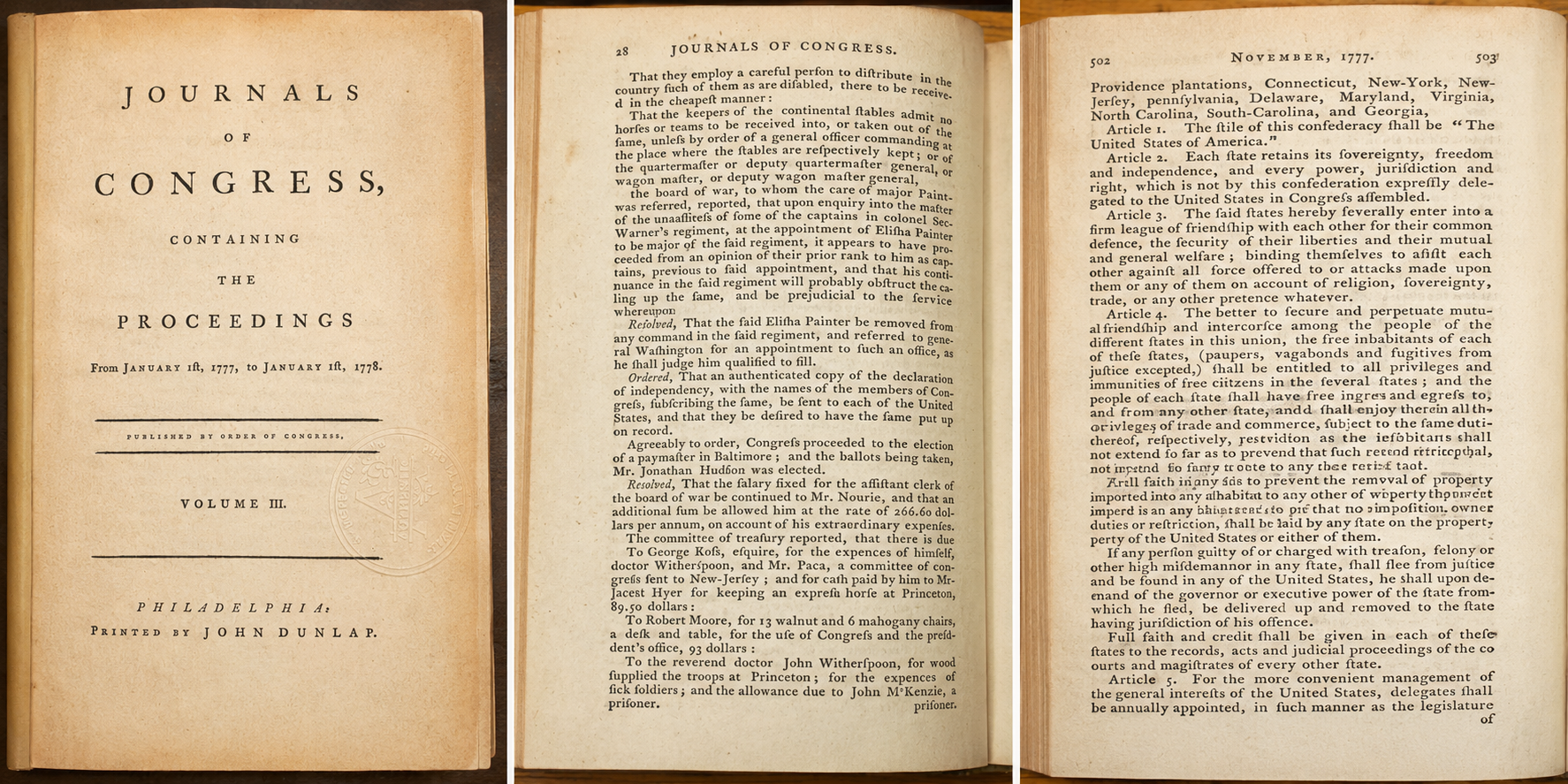
Journals of Congress: Containing the Proceedings from January 1, 1777, to January 1, 1778. Volume III. Philadelphia: John Dunlap, 1778. First Edition.
This historic volume is among the most important publications issued by the Continental Congress. Printed under congressional authority by John Dunlap, it records the proceedings of Congress during one of the most pivotal years of the American Revolution.
The Journals chronicle Congress's wartime deliberations as it struggled to sustain the Revolution while relocating from Baltimore back to Philadelphia and later to York, Pennsylvania. Within its pages are resolutions concerning military operations, diplomacy with Native American nations, foreign loans and alliances, the financing of the war, and the day-to-day administration of the emerging United States.
One of the volume's most significant entries appears on January 18, 1777, when Congress ordered the following:
"...an authenticated Copy of the Declaration of Independency, with the Names of the Members of Congress subscribing the same, be sent to each of the United States..."
That resolution authorized Baltimore printer Mary Katharine Goddard to produce the first public printing of the Declaration of Independence bearing the names of its signers. The volume displayed here is opened to that historic resolution.
Later in the year, on November 15, 1777, Congress adopted the Articles of Confederation, America's first national constitution. This volume contains the first official printing of the Articles as approved by Congress and transmitted to the states for ratification. The Articles provided the legal framework under which the United States governed until the Constitution took effect in 1789.
Together, the Goddard printing resolution and the first official printing of the Articles of Confederation make this one of the most historically significant volumes published during the Revolutionary era.
This first edition of the Journals of Congress preserves the official record of the Continental Congress during 1777, documenting both the first authorized public printing of the Declaration's signers and the adoption of the Articles of Confederation. Few Revolutionary publications better illustrate the evolution of the United States from a collection of rebelling colonies into a constitutional union.
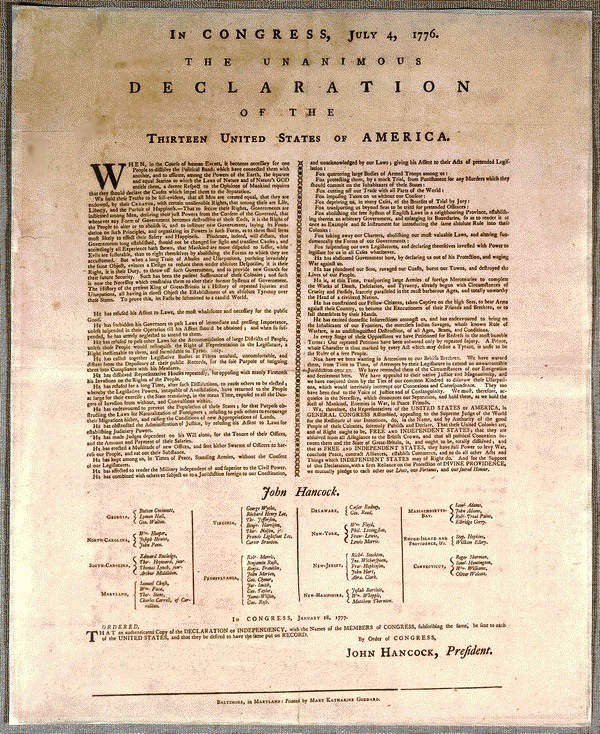
THE GODDARD BROADSIDE: The First Public Printing of the Signers
Franklin Court Printing Office Facsimile, 2015
Reproduction of the January 1777 Goddard Broadside
When the Declaration of Independence was first printed on July 4, 1776, the names of its signers were omitted. The Dunlap Broadside, distributed throughout the colonies, identified only John Hancock, President of Congress, and Charles Thomson, Secretary.
After British forces occupied Philadelphia, the Continental Congress fled to Baltimore. Encouraged by the American victories at Trenton and Princeton, Congress took an important step toward publicly identifying those who had pledged "their Lives, their Fortunes and their sacred Honor."
On January 18, 1777, Congress resolved that:
"...an authenticated Copy of the Declaration of Independency, with the Names of the Members of Congress subscribing the same, be sent to each of the United States..."
Congress selected Mary Katharine Goddard, Baltimore's accomplished printer and postmaster, to produce this official broadside. Her edition became the first public printing of the Declaration to include the names of the signers, transforming an anonymous declaration into a public roll call of revolution. By printing their names, Congress knowingly exposed its members to charges of high treason should the Revolution fail.
Nine original Goddard Broadsides are presently known to survive, making them among the rarest and most significant printed documents of the American Revolution.
MARY KATHARINE GODDARD (1738–1816)
Printer, publisher, bookseller, and Baltimore's postmaster, Mary Katharine Goddard was one of colonial America's most accomplished businesswomen. Trusted by the Continental Congress for the quality of her work, she printed the historic January 1777 broadside that first publicly identified the signers of the Declaration of Independence. Today, she is remembered as one of the most significant female printers of the Revolutionary era.
ABOUT THIS FACSIMILE
This faithful facsimile was hand printed in 2015 at the Franklin Court Printing Office & Bindery, part of Independence National Historical Park in Philadelphia. Produced using traditional eighteenth century printing techniques, it faithfully reproduces the appearance and craftsmanship of one of America's most celebrated Revolutionary documents.
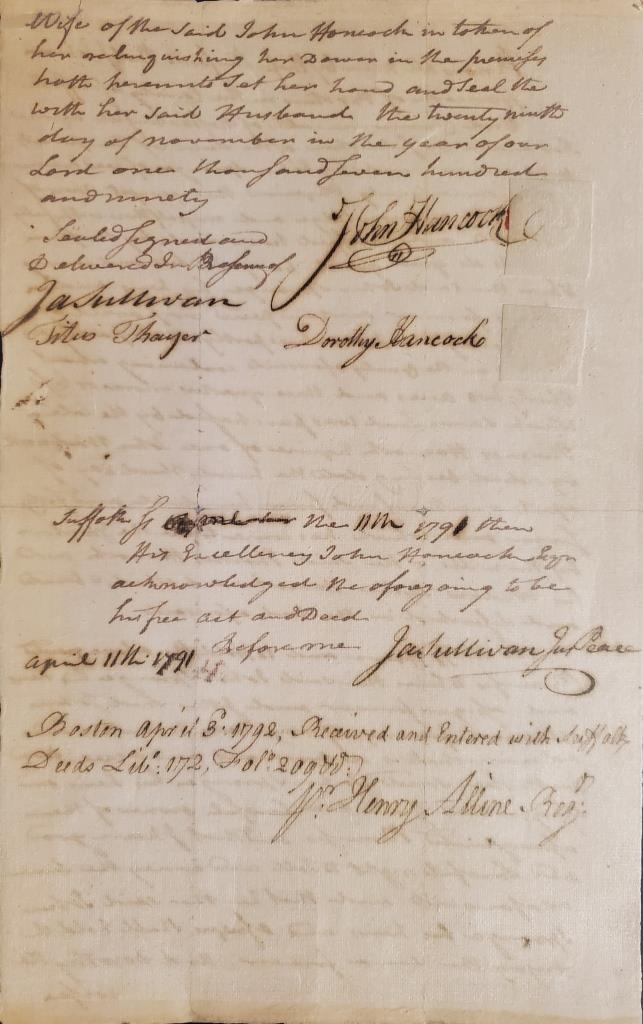
John Hancock & Dorothy Quincy Hancock Deed, Signed by America's First First Lady
This 1790 land deed bears the signatures of John Hancock, President of the Continental Congress, first signer of the Declaration of Independence, and Governor of Massachusetts, together with his wife, Dorothy Quincy Hancock. Documents signed by Dorothy Hancock in her own right are exceptionally scarce, making this deed a remarkable artifact connecting two of the most prominent figures of the Revolutionary generation.
Dorothy Quincy Hancock was far more than the wife of a famous patriot. In April 1775, after receiving word of the British march from Boston, she fled Lexington alongside John Hancock and Samuel Adams before the opening shots of the Battles of Lexington and Concord. Throughout the Revolutionary War, she managed the Hancock household, maintained relationships with many of New England's leading patriot families, and served as her husband's confidante during years of extraordinary political responsibility.
While John Hancock presided over the Continental Congress from 1775 to 1777, Dorothy helped sustain the social and domestic networks that supported the patriot cause. Her intelligence, grace, and political awareness earned the admiration of contemporaries, making her one of the most recognized women of the Revolutionary era. Historians often regard Dorothy Quincy Hancock as America's "First First Lady," reflecting the prominent public role she occupied while her husband served as the nation's first presiding executive under the Continental Congress.
Together, the signatures of John and Dorothy Hancock connect visitors not only to the political history of American independence but also to the personal lives of the nation's founding generation. This deed reminds us that the American Revolution was shaped not only by statesmen and soldiers, but also by the women whose leadership, sacrifice, and steadfast support helped sustain the cause of liberty.
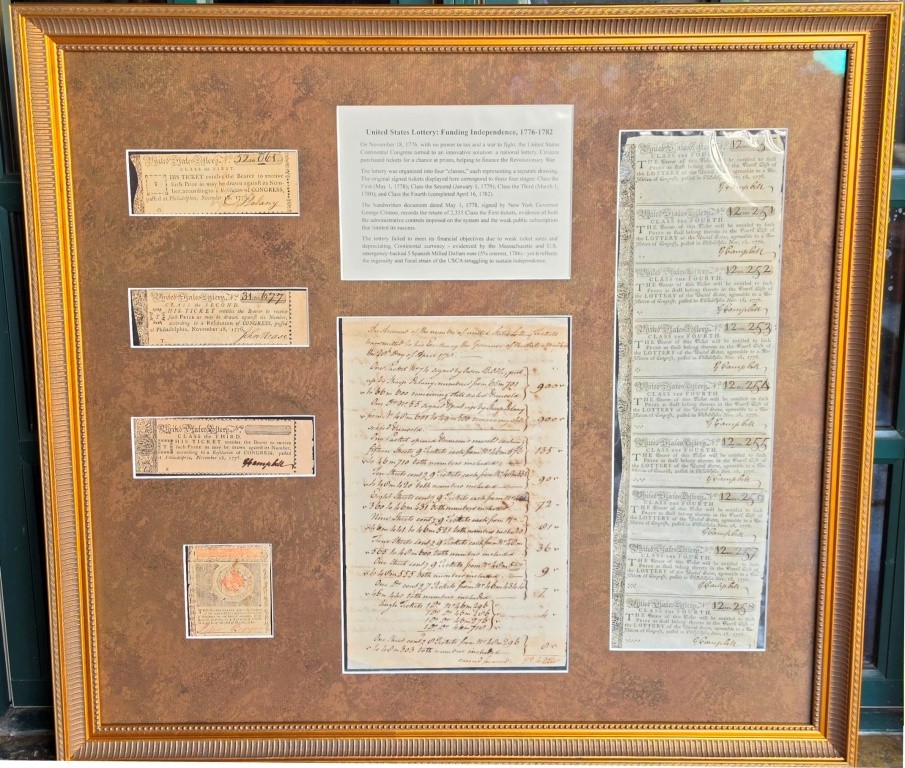
United States Lottery: Funding Independence, 1776-1782
On November 18, 1776, with no power to tax and a war to fight, the United States Continental Congress turned to an innovative solution: a national lottery. Citizens purchased tickets for a chance at prizes, helping to finance the Revolutionary War.
The lottery was organized into four “classes,” each representing a separate drawing. The original signed tickets displayed here correspond to those four stages: Class the First (May 1, 1778); Class the Second (January 1, 1779); Class the Third (March 1, 1780); and Class the Fourth (completed April 16, 1782).
The handwritten document dated May 1, 1778, signed by New York Governor George Clinton, records the return of 2,335 Class the First tickets, evidence of both the administrative controls imposed on the system and the weak public subscription that limited its success.
The lottery failed to meet its financial objectives due to weak ticket sales and depreciating Continental currency, evidenced by the Massachusetts and U.S. emergency-backed 5 Spanish Milled Dollars note (5% interest, 1786) - yet it reflects the ingenuity and fiscal strain of the USCA struggling to sustain independence.
Exhibited by the University of New Mexico Honors College in the Zimmerman Library, June 26th – August 3rd, 2026, in commemoration of the 250th anniversary of the Declaration of Independence and the birth of the United States of America.


Social Media
For news, information, prizes and more fun stuff follow us on our social media!
Honors College Resources