Insights at the intersection: A unique collaboration in Honors
September 30, 2026 - Kimberly Delker
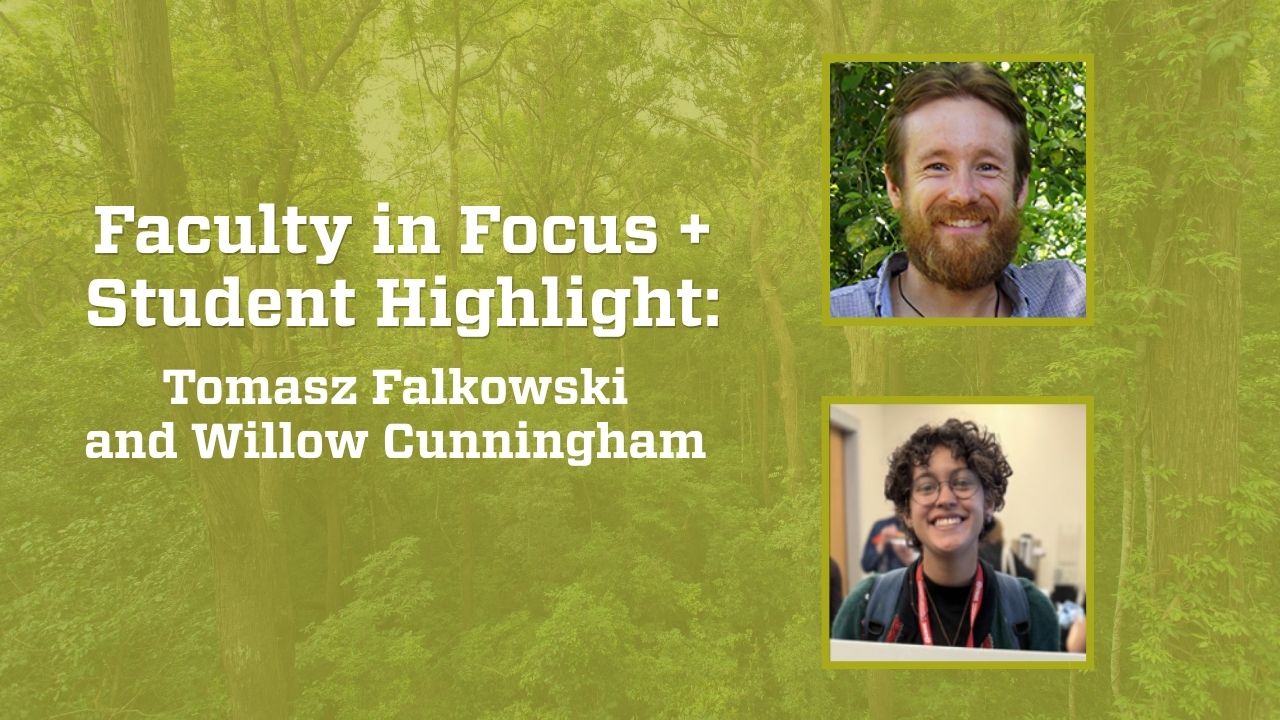
Planting trees in a community is a commonplace activity and seems fairly straightforward. Select an appropriate tree; make sure there is optimal space, soil and drainage; plant it, and with a little care (including sunshine and water), watch it flourish for years to come. There is a science in how to plant, what living things need to survive and thrive, and what is detrimental to their wellbeing.
But planting a tree is not just a scientific decision. It is also a cultural one, if you consider a tree not just as a living organism but a vital ingredient in building and maintaining community.
It is at that intersection of science and culture where Tomasz Falkowski and Willow Cunningham have found a unique collaboration.
Falkowski, an applied ecologist, is in his third year as an assistant professor in the Honors College. He specializes in taking an interdisciplinary lens to study socioecological systems, examining the relationships between ecological and human communities, and how they can be restored.
Cunningham, a senior in biology, approaches their plan of study and research informed by various perspectives. It is shaped by their cultural and racial background that Cunningham calls Nuevo Mexicane — a racial mix of indigenous, Mexican, and Spanish — while considering issues like socioeconomics and food sovereignty. “I’m in two different realms.”
The project they are collaborating on is a project that dates back to 2013 that involves restoring the tropical forest in Chiapas, Mexico, after land-use change. Reforestation is framed in the lens of not just planting trees, but on keeping with traditional Maya agroforestry practices, as well as keeping socioeconomic and cultural impact of restoration efforts in the forefront.
Cunningham first learned about Falkowski’s research in a course their first semester at UNM called “Legacy of Wilderness.”
“We’ve been working together ever since,” Cunningham said.
Cunningham will graduate with a bachelor’s degree in December, then will pursue a Ph.D. in biology with a specialization in ethnobiology.
Cunningham describes their work as based in science but steeped in rich, community-based knowledge and insights. “Numbers wouldn’t mean anything without the larger context of how they are impacting communities,” they said. “This research is part of an inclusive process where the community shapes the questions.”
Falkowski has learned from the collaboration as well. “Willow has pushed me on how to incorporate community-engaged research.”
Trained as a bioengineer, Falkowski admits he takes comfort in that which can be scientifically measured or proven.
“I like numbers because they are precise, but that precision is illusory,” he said. “They need to be placed in the context of qualitative data because we are not purely rational beings.”
He said the idea of STEAM (Science, Technology, Engineering, Arts and Mathematics) allows us to "recognize how both operate in complementary and synergistic ways to augment our understanding of the world."
“I like to think of science as a form of storytelling,” Falkowski said. “What is the narrative? What is the story?”
For Cunningham, who is also studying in a scientific field, community-engaged research has also pushed them into some broader areas that can introduce discomfort, but are necessary for the kind of impact they hope to achieve in their work. “Interdisciplinary research is about bettering the world around me.”
Ultimately, Falkowski said, “It gets messy, but that’s where the good stuff is.”