Worn Stories: Fashion as Cultural Connection
Seminar - UHON 401
Instructor(s): Megan Jacobs
Course Description
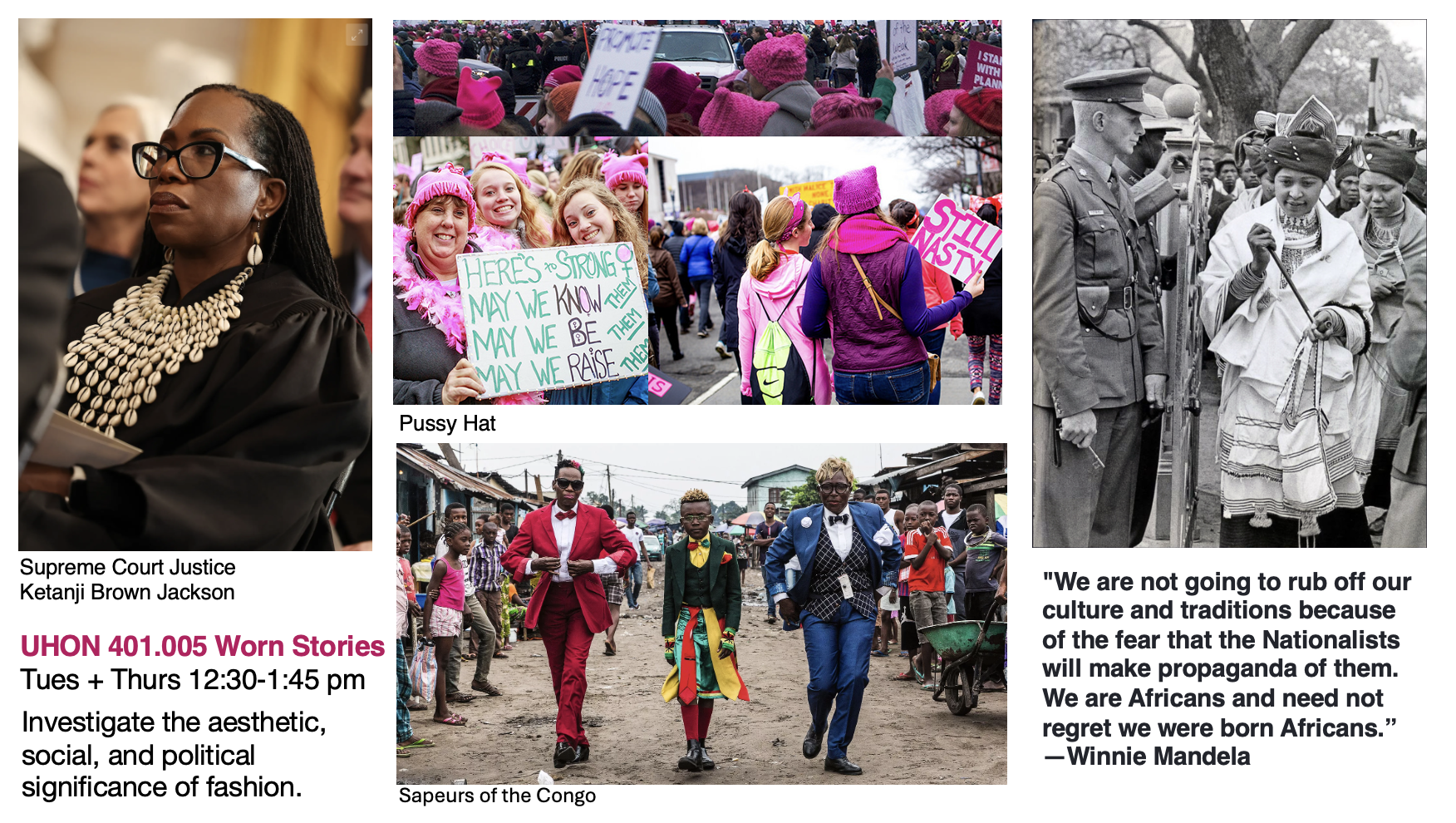
Can you recall the clothes you wore on the first day of school? Your 16th birthday? Your first date? Clothes are more than what we put on our bodies. They are tools for communicating our identity. This course will investigate the aesthetic, social, and political significance of fashion.
Historically and in contemporary times, we see fashion as a tool for building community and solidarity, whether to reject or affirm the status quo. From suffragettes' white dresses, to Nelson and Minnie Mandela’s selection of traditional Xhosan attire for the Truth and Reconciliation Trials, to the pink pussyhat, clothing has symbolic and political meaning within a given context. We will research, unpack, and decode the significance of historic and contemporary dress.
In addition to the socio-political context of clothing, we will explore the environmental impacts of the fashion industry–textile waste, labor conditions, as well as emerging sustainable practices. We will participate in hands-on mending strategies, such as the Japanese method of Sashiko mending, a form of visible repair that promotes sustainable practices as well as other sewing techniques.
Texts
REQUIRED TEXTS
- Worn Stories, Emily Spivack
- Women in Clothes, Shelia Heti
- Loved Clothes Last: How the Joy of Rewearing and Repairing Your Clothes Can Be a Revolutionary Act, Orsola de Castro
- Fashion and Politics, Djurdja Bartlett
- The Fashion Reader, 3rd edition by Linda Welters (Editor), Abby Lillethun (Editor)
All excerpted readings are available on the course outline accessible through Canvas.
Readings on the class website draw from the following excerpted sources:
- Worn in New York: 68 Sartorial Memoirs of the City, Emily Spivack
- Worn: A People’s History of Clothing, Sofi Thanhauser
- Fabric: The Hidden History of the Material World, Victoria Finlay
- On Mending: Stories of damage and repair, Celia Pym
- Real Clothes, Real Lives: 200 Years of What Women Wore, Kiki Smith
- Everything You Wanted to Know About Indians But Were Afraid to Ask: Young Readers Edition, Anton Treuer
- Native Fashion Now: North American Indian Style, Karen Kramer
- From the Rez to the Runway, Chris Allaire
- The Power of Style, Chris Allaire
- Why We Can't Have Nice Things: Social Media’s Influence on Fashion, Ethics, and Property, Minh-Ha T. Pham
- A Philosopher Looks at Clothes, Kate Moran
FILMS + PODCASTS
- Articles of Interest, Podcast
- Worn Stories, Emily Spivack, Documentary
- Suited, Documentary
Requirements
Attendance/Participation 180 points
Oral Presentation/Discussion Leadership 200 points
Worn Stories: New Mexico 200 points
Mending and Remaking as Sustainable Practices 200 points
Final Fashion Project 200 points
Honors Week Written Reflection 20 points
Attendance & Discussion Participation, 180 points
Full, active engagement is demonstrated through thoughtful comments, active listening, and the ability to foster class discussions. Since this course requires active engagement and hands-on exercises, your attendance is crucial to your success.
Oral Presentation + Discussion Leadership, 200 points
You will work with a partner to develop a 45-minute interdisciplinary presentation and class discussion that connects your research on a specific garment and its maker with a scholarly reading from the class. You will research your selected garment through aesthetic, social, and political lenses and drive home these points through class discussion.
Worn Stories New Mexico, 200 points
Clothes are more than what we put on our bodies. They are tools for communicating our identity. Clothes carry personal, familial, social, and political meaning. In this project, you will conduct an oral history interview (with supplemental photographs of the article) with a New Mexican about the meaning of a particular garment they hold dear. The oral history interview will focus on the garment's history and its personal and social significance.
Mending and Remaking as Sustainable Practices, 200 points
Our readings on the environmental ramifications of fast fashion clearly demonstrate how detrimental the industry can be to the planet, from workers’ rights to pollution from discarded textiles. Wearing clothes as long as possible helps to break this cycle of disposal. We will learn “repair” methods used by artisans and seamstresses from New York to Tokyo to Cape Town. We will employ these techniques to salvage an existing personal or thrifted garment, breathing new life and meaning into the piece.
Final Fashion Project, 200 points
Reflecting on our readings, class discussions, and exercises over the course of the semester, you will have the option to:
1) create a 10-minute podcast episode (in the spirit of Articles of Interest) that explores the time period, aesthetic, social, and political significance of a garment, movement, creator, or practice in the fashion industry.
2) present your research findings to the class in a polished 10-minute oral presentation that explores the time period, aesthetic, social, and political significance of a garment, movement, creator, or practice in the fashion industry.
3) re/create through hand or machine sewing, a garment that you will share and present to the class, for which the design addresses a personal, social, or political issue.
Honors Week Reflection, 20 points
Attend at least two Honors Week presentations, ideally linked to themes we are exploring in our class. You’ll prepare a written reflection on the events you attend.
About the Instructor(s): Megan Jacobs
Megan Jacobs’ work has been exhibited broadly in over 100 solo and group shows nationally and internationally including exhibitions at Aperture Gallery, Saatchi Gallery, the Museum of New Art (MONA), The FENCE, Blue Sky Gallery, and Currents New Media Festival. Her work has been featured in Adbusters, Musee Magazine, Lenscratch, Feature Shoot, and Frankie Magazine. She earned a BA in Fine Art from Smith College and an MFA from the University of New Mexico. Her work was recently published in an anthology of women photographers, Eye Mama: Poetic Truths of Home and Motherhood.
Megan’s interdisciplinary honors courses range from a philosophical exploration of the good life, to evaluating art’s role as a socio-political tool, to exploring identity through photography. Broadly, her courses help students to hone their critical thinking skills in order to creatively construct their way in the world. Jacobs’ recent creative and pedagogical efforts explore the precarious relationship between humans and the natural world. She co-developed and team taught the course, Eco-Art: Making Art to Reconcile with the Climate Crisis, with an honors student, Kineo Memmer, and was awarded the 2022-2023 Outstanding Teacher of the Year Award. Jacobs’ series, Shared Breath: Motherhood in the Time of Climate Crisis, was recognized with the 2024 Lauren Shrensel Zadikow Award for social/environmental art from the Society for Photographic Education. Megan co-curated the environmental exhibit, Eco-Pulse: Rise and Fall, in partnership with curator Mary Statzer at the University of New Mexico Art Museum. Jacobs is a founding member of the UNM Interdisciplinary Design Certificate.



Social Media
For news, information, prizes and more fun stuff follow us on our social media!
Honors College Resources